


Admin
Buy from $40/yr

Free companion app Windows and Mac

The free control center for every APS machine on your network

One page for the whole rig. See what each machine is showing, change settings and push files from front of house, and keep main and backup on the same slide — without touching the presentation computer.

Auto Presentation Switcher runs your presentations. APS Hub provides remote control. Each presentation computer needs Auto Presentation Switcher 4.5 or later. APS Hub is free and does not replace it.
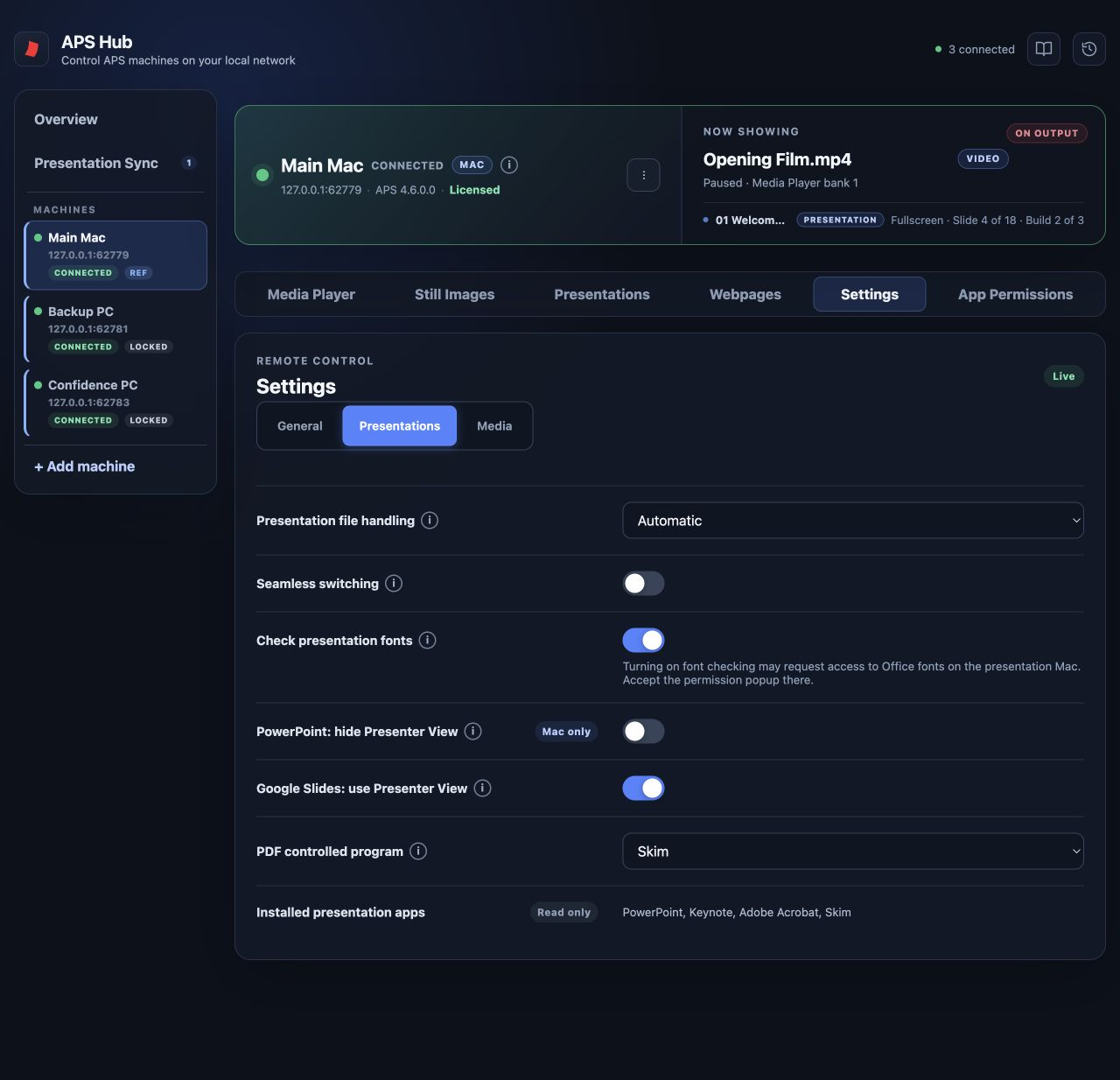
APS Hub with three connected machines, Main Mac output layers, and Settings → Presentations selected beneath the General, Presentations and Media section tabs

The operator's page for the whole rig

Operate your APS machines from a laptop, phone or tablet on the same network, with familiar APS controls in your browser.

  • Prepare presentation fonts. Review APS font warnings, install .ttf and .otf fonts on a selected computer, and restart PowerPoint when needed. Font tools require APS Hub 1.1 and APS 4.6 or later.
  • Now showing. See each machine's live output status, slide and animation progress, and any layers covering the presentation.
  • Control from your seat. Change APS settings and operate presentations, media, still images and webpages while the show runs.
  • Push a file to a machine. Upload a corrected deck, video or image into an APS slot, or add presentation files directly to a configured presentation folder, with every transfer verified.
Machine controls in the Hub user guide
APS Hub Main Mac showing paused Opening Film.mp4 above 01 Welcome.pptx, with Settings → Presentations, General and Media section tabs, and Check presentation fonts enabled
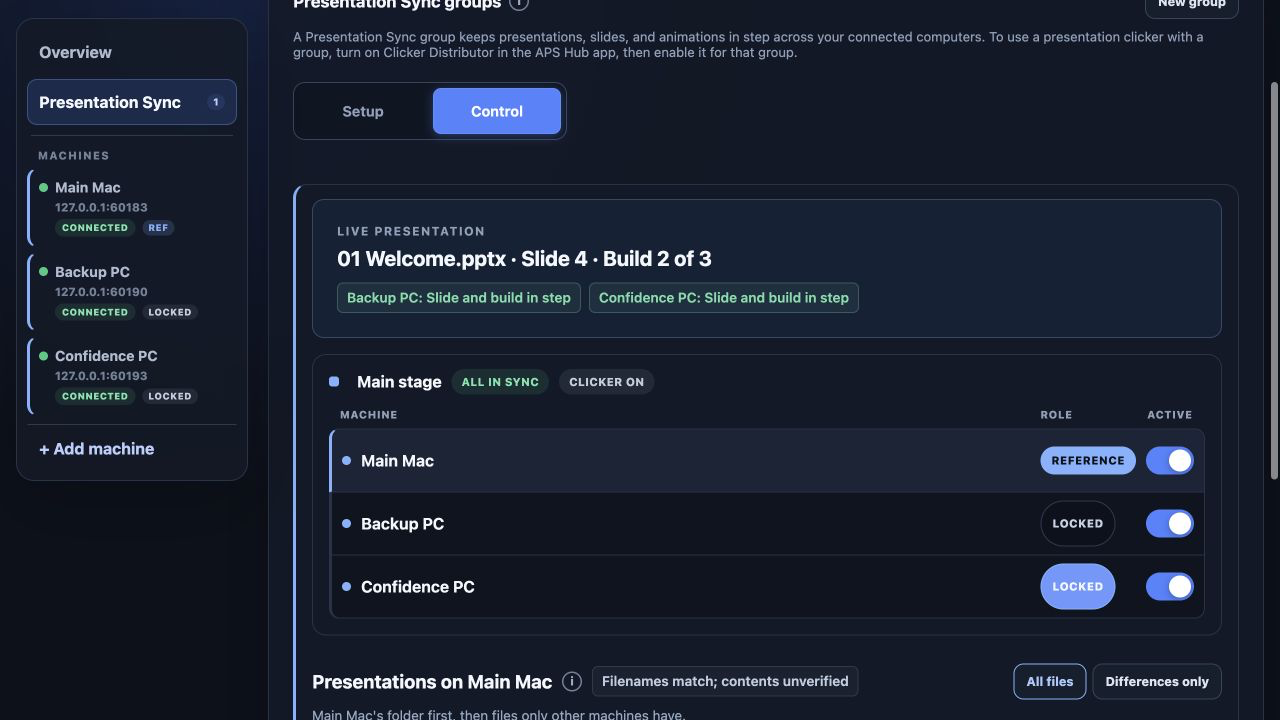
APS Hub Presentation Sync group with Main as Reference, Backup and Confidence Locked, and the All in sync badge

Same deck on two machines, same slide

Main and backup, stage and confidence monitor, a second room: when the same presentation runs on more than one computer, Hub keeps them together. Put the machines in a group, pick one as the reference, and the others follow it — presentation, slide and animation step — however the reference was driven.

Hub doesn't forward keystrokes blindly. It reads the position back from every machine, corrects only the ones that differ, and shows an honest status: green in step, amber correcting, red needs you.

How Presentation Sync works

One clicker, every machine

Plug the presenter's clicker receiver into the computer running Hub, and every Next and Previous goes to the whole Presentation Sync group at the same time. Any clicker that sends Page Up and Page Down works, which is nearly all of them. Spare buttons can black out, freeze, or put a still image on every screen in the room.

Clicker Distributor in full
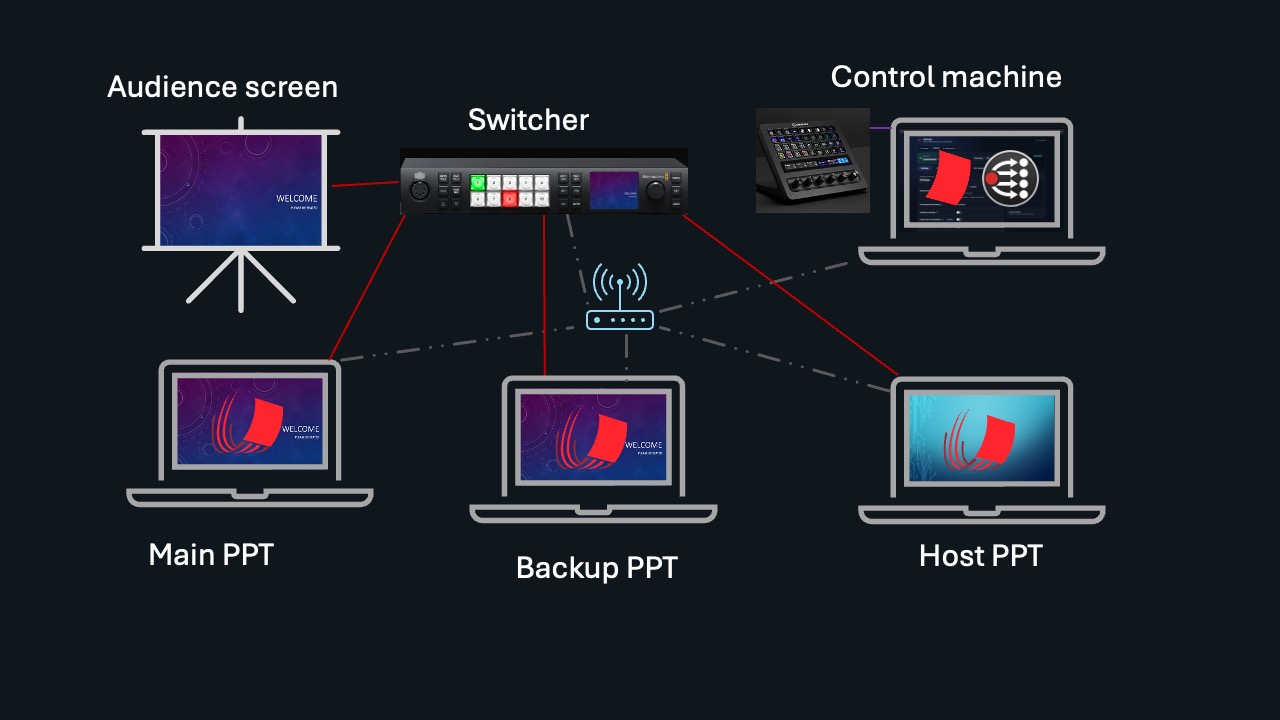
Diagram of three APS presentation computers, a video switcher, audience screen, and a control machine running APS Hub and Bitfocus Companion on the same network
A typical setup: three presentation computers, one control machine running APS Hub and Bitfocus Companion, all on one network.

Stream Deck for the buttons you press all show long. Hub for everything else.

Bitfocus Companion and Stream Deck stay the primary way to control APS; nothing beats a physical button for the commands you fire constantly. But Companion was never meant to be a complete interface for an application, and rebuilding all of APS in buttons takes five or six pages. Hub is the instant remote UI and the sync brain; Companion is the cue list and the buttons. They coexist, and can control the same machines. Anything Hub does is built on the same public API Companion uses.

Getting started

  1. 1

    Install APS 4.5 or later on every presentation computer. APS is the paid app that opens and runs the presentations.

  2. 2

    Install the free APS Hub on your control computer. It lives in the menu bar or system tray; the control page opens in your browser. On Mac, pick the installer for your chip.

  3. 3

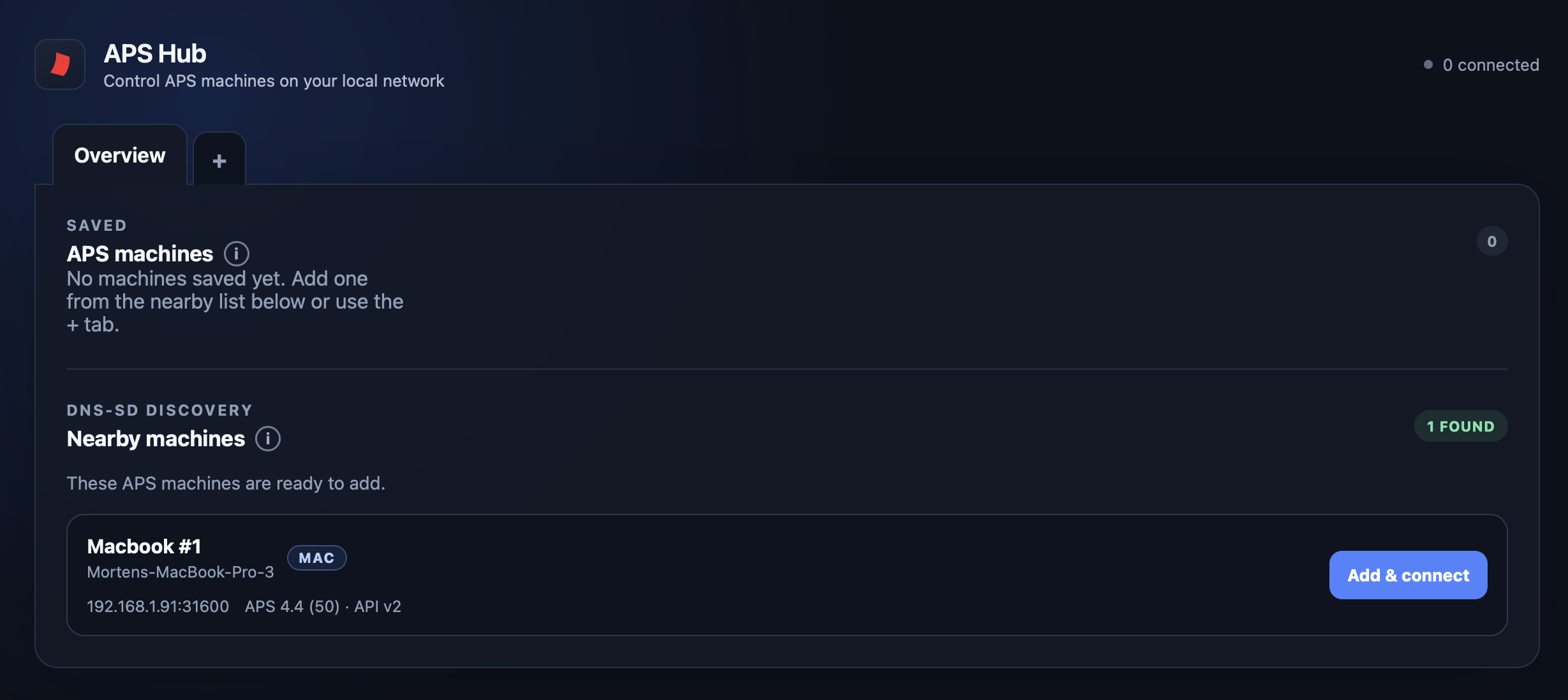
    Connect. APS machines announce themselves on the network, so they appear in Hub by themselves — click Add. Machines that don't show up can be added by IP and port, the same as in Companion.

  4. 4

    Open a machine and take over. Now showing, settings and the APS tabs are live straight away. Running the same deck on more than one machine? Create a Presentation Sync group.

APS Hub Overview showing a nearby APS machine found on the network with the Add and connect button
APS machines announce themselves on the network — just add and connect.

What Hub doesn't do

Hub replaces most walks to the presentation computer, not all of them.

Presentation Sync has its own list.

  • Desktop dialogs. If PowerPoint or the operating system asks a question, someone still answers it at that machine.
  • Cloud or internet control. Hub is LAN only. The control page is served on your local network without a login, so run it on a network you trust.
  • Keeping folders identical. Hub uploads files into slots or configured presentation folders and compares the filenames and contents of watched presentation folders. It doesn't continuously mirror folders between machines — a shared folder, Syncthing or Dropbox does that, and Hub works on top of it.
  • Video output, capture, NDI. Hub is a control surface. APS produces the output; Hub never touches the picture.
  • Full file-system access, thumbnails, previews. Hub lists and manages presentation files in APS's configured folders, including uploads and deletion to Trash or Recycle Bin. It doesn't browse the whole machine or show media thumbnails.
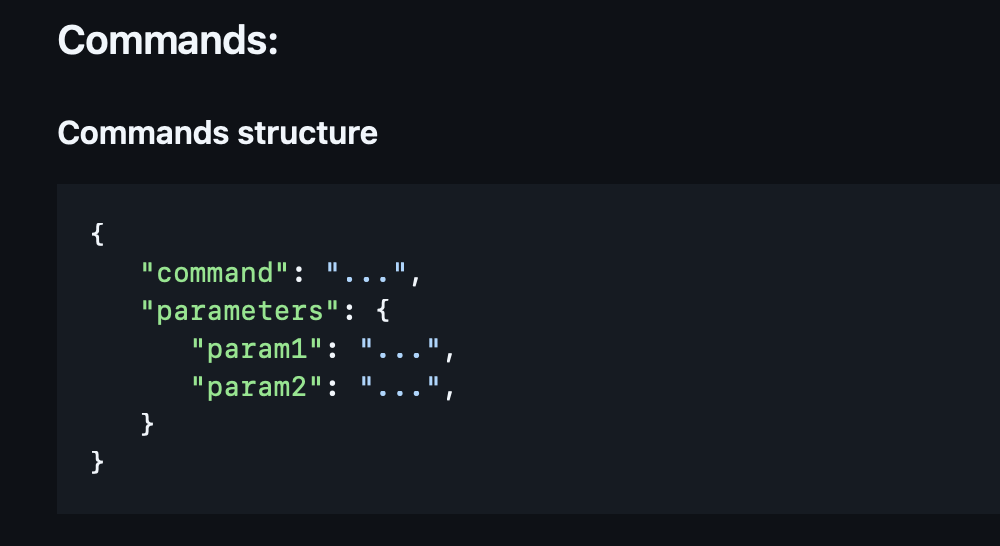
APS API documentation showing a JSON command with a command name and parameters
APS commands use a straightforward JSON structure: name the command, then provide the parameters it needs. Hub uses this same public API to control connected APS machines.

Built on the open APS API

APS Hub is built entirely on the public APS API — the same API that powers the Bitfocus Companion module, with a few additions we made for Hub, like auto-discovery of APS machines on the network. (Auto-discovery will make its way into the Companion module at a later stage, too.)

The API is open for anyone to use, and that's part of why we built Hub in the first place: to show what's possible with APS, and to serve as a working reference for controlling APS over the network.

Explore the APS API

APS Hub is free. APS is paid.

Hub is a free companion app and will stay free — no account, no licence key. It doesn't open or run presentations by itself. Each presentation computer needs APS 4.5 or later with a paid APS licence for unrestricted use.

Hub app: free forever

Requirements

  • Hub computer: macOS 13.5 or newer (Apple Silicon and Intel) or 64-bit Windows.
  • Presentation computers: APS 4.5 or later on every one.
  • Network: a local network.
Hub user guide